
Overview
From 1 July 2026, the NSW Government introduced the Development Coordination Authority (DCA) as the central point for NSW Government referrals associated with local development applications. The DCA consolidates assessment and advice that was previously obtained directly from individual NSW Government agencies and provides a single, coordinated response to the consent authority.
For development requiring a Bush Fire Safety Authority under section 100B of the Rural Fires Act 1997, the substantive approval pathway has not been removed. The principal change is administrative: the consent authority now refers the development application to the DCA for the General Terms of Approval, rather than referring the application directly to the NSW Rural Fire Service for those terms.
In practical terms, it is effectively the same integrated development process, but the referral and coordination stage now occurs through the DCA. Additional information is at the DCA website: https://www.planning.nsw.gov.au/the-planning-system/housing/development-coordination-authority
What has changed?
Previously, where a subdivision or special fire protection purpose development required a Bush Fire Safety Authority, the consent authority generally referred the development application directly to the NSW Rural Fire Service to obtain its General Terms of Approval.
For applications lodged on or after 1 July 2026:
- the consent authority identifies that the development is integrated development;
- the consent authority submits the application to the DCA for a referral check;
- the consent authority formally refers the application to the DCA through the NSW Planning Portal;
- the DCA coordinates the relevant NSW Government technical assessment, including specialist bushfire input where required;
- the DCA issues the General Terms of Approval or advises that the required approval will not be granted; and
- the consent authority determines the development application having regard to the DCA response.
For integrated development, the DCA issues the GTAs relating to the separate statutory approval. If the DCA advises that the required approval will not be granted, the consent authority must refuse the development application. If development consent is granted, it must be consistent with the GTAs issued by the DCA.
What has not changed?
The establishment of the DCA does not remove or replace the requirement to obtain a Bush Fire Safety Authority.
A Bush Fire Safety Authority remains a separate statutory approval issued by the Commissioner of the NSW Rural Fire Service under section 100B of the Rural Fires Act 1997. The DCA does not issue the Bush Fire Safety Authority. Its role is to coordinate the integrated development assessment and issue the GTAs that establish the requirements applying to the subsequent approval.
Following the grant of development consent, the applicant must still apply to the NSW Rural Fire Service for the Bush Fire Safety Authority. The development cannot lawfully be carried out until that authority has been obtained. The Bush Fire Safety Authority must operate consistently with the development consent and the General Terms of Approval incorporated into that consent.
The NSW Rural Fire Service also retains responsibility for:
- issuing the Bush Fire Safety Authority;
- maintaining bushfire policy and technical standards;
- administering Planning for Bush Fire Protection;
- exercising its statutory regulatory and compliance functions; and
- providing specialist bushfire input to the DCA where required.
The DCA therefore changes the referral interface, but it does not transfer the NSW Rural Fire Service’s statutory approval function.
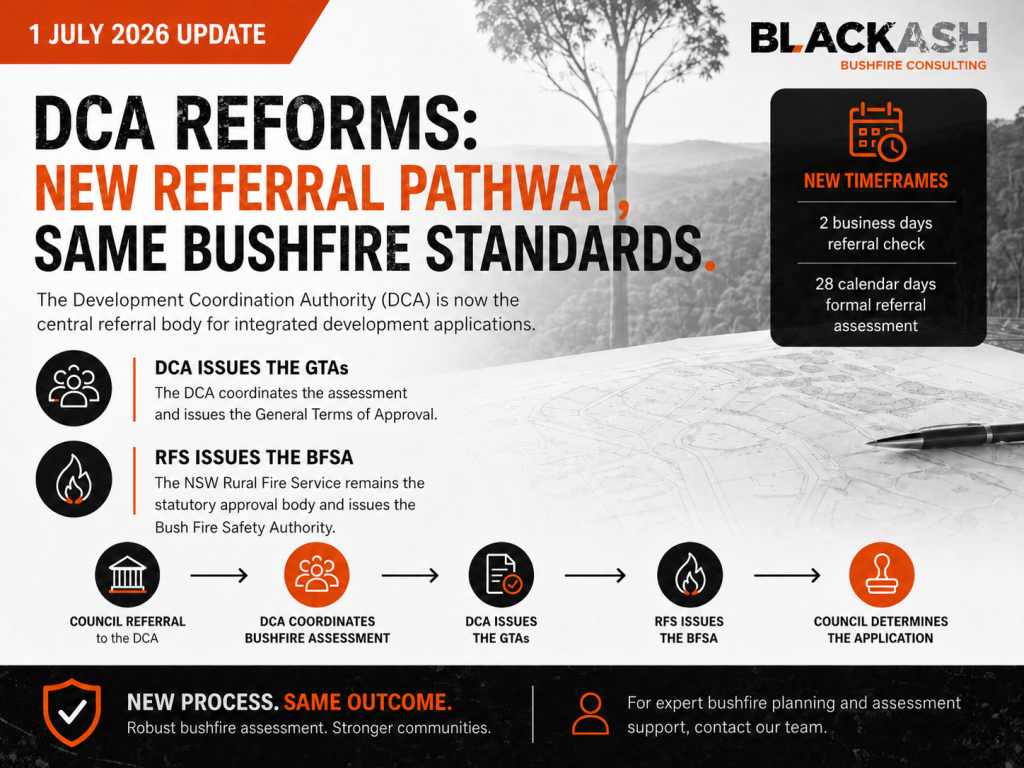
New referral timeframes
Before a formal referral is made, the consent authority must submit the application to the DCA for a referral check. This allows the DCA to confirm whether a referral is required and whether sufficient information has been provided.
The DCA has 2 business days to undertake the referral check. If the DCA does not respond within that period, the consent authority may proceed with the formal referral. The referral check does not form part of the formal statutory referral timeframe.
Once the formal referral is made through the NSW Planning Portal and the required referral fee is paid, the DCA has 28 calendar days to provide its response.
The 28-day period:
- begins when the formal referral has been made and the applicable fee has been paid;
- pauses if the DCA requests additional information; and
- restarts when the requested information is provided.
If no response is received within the applicable 28-day period, the consent authority may proceed to determine the development application in accordance with the legislative framework.
A referral fee of $1,100 per referral matter currently applies to local development applications referred to the DCA. Where more than one separate referral requirement applies, multiple referral fees may be payable.
Effect on current applications
The new arrangements apply according to the date on which the development application was lodged:
- applications lodged before 1 July 2026 generally continue under the former referral framework and are referred directly to the relevant NSW Government agency;
- applications lodged on or after 1 July 2026 are subject to the new DCA referral framework; and
- where a non-minor amendment to an existing application is accepted after 1 July 2026, the lodgement date may reset and the application may become subject to the new framework.
The applicable referral process and timeframes should therefore be confirmed for each application, particularly where an application was lodged before 1 July 2026 but has subsequently been materially amended.
Practical effect for applicants
For applicants, the reform represents a change in process rather than a material reduction in bushfire assessment requirements.
A development application requiring a Bush Fire Safety Authority must still be supported by a comprehensive Bushfire Assessment Report demonstrating compliance with Planning for Bush Fire Protection and addressing matters such as:
- asset protection zones;
- access and evacuation;
- water supply;
- landscaping and vegetation management;
- building construction;
- subdivision design; and
- any proposed performance-based solution.
The principal procedural difference is that Council now refers the application to the DCA, and the DCA coordinates the bushfire assessment and issues the GTAs. The RFS remains involved where specialist bushfire input is required and remains responsible for issuing the subsequent Bush Fire Safety Authority.
Applicants should therefore not assume that the creation of the DCA lowers the technical standard of assessment or removes the RFS from the approval process. The purpose of the reform is to establish a single referral pathway, improve coordination between NSW Government technical disciplines and reduce fragmented or duplicative agency engagement.
Summary
The new process can be summarised as follows:
Development application lodged with Council
→ DCA referral check
→ formal referral to DCA
→ DCA coordinates specialist bushfire assessment
→ DCA issues GTAs
→ Council determines the development application consistently with the GTAs
→ applicant obtains the Bush Fire Safety Authority from the NSW Rural Fire Service
→ development may proceed subject to all approvals and consent conditions.
Accordingly, the integrated development pathway remains substantively the same. The major change is that the General Terms of Approval are now issued through the DCA, while the NSW Rural Fire Service continues to issue the Bush Fire Safety Authority under the Rural Fires Act 1997.


